I still remember the exact moment I saw the headline about Marvel Rivals. As a regular player who has spent hundreds of hours battling across Yggsgard and Tokyo 2099, I expected another story about how the developers were listening to feedback or how the player count kept climbing. Instead, the biggest news was brutally simple: despite the game's massive success and unprecedented player retention, Marvel Rivals director Thaddeus Sasser and his entire team had been laid off by NetEase.
That contradiction still stings in 2026. How can a game be performing this well and still see its leadership cut? It is a question I have asked myself many times, and it reflects a much bigger problem across the industry right now. Job security feels like a myth, and even the people behind a breakout hit are not safe.
Amid the layoff shock, the game itself kept moving forward. Earlier that same month, NetEase dropped a trailer for the upcoming Central Park map, and I have to admit, it looks spectacular. Dracula has taken over one of the most iconic locations in New York City, turning it into a gothic nightmare. The trailer shows a fascinating blend of the vampire's castle and the Central Park we used to know, with twisted trees, moonlight, and an imposing lair that feels ripped straight out of a horror film.
The official description explained that when the Timestream Entanglement swept over New York City, Dracula seized the opportunity with Doctor Doom's gift. He stopped the moon and declared an eternal night using the power of Chronovium. Now, the heroes are ready to take the battle straight to his gothic headquarters within Central Park. That premise alone is enough to make any Marvel fan excited.
Alongside the map, Marvel Rivals also prepared to welcome two members of the Fantastic Four. The Human Torch and The Thing were set to arrive on February 21, 2025, the same day the Central Park map became available. I still remember the community buzzing about how these two would change the meta. The Human Torch looked like a highly mobile damage dealer, while The Thing promised to be a frontline brawler. Adding them at the same time as a Dracula-themed map felt like a bold content drop, especially when the studio had just lost its director.
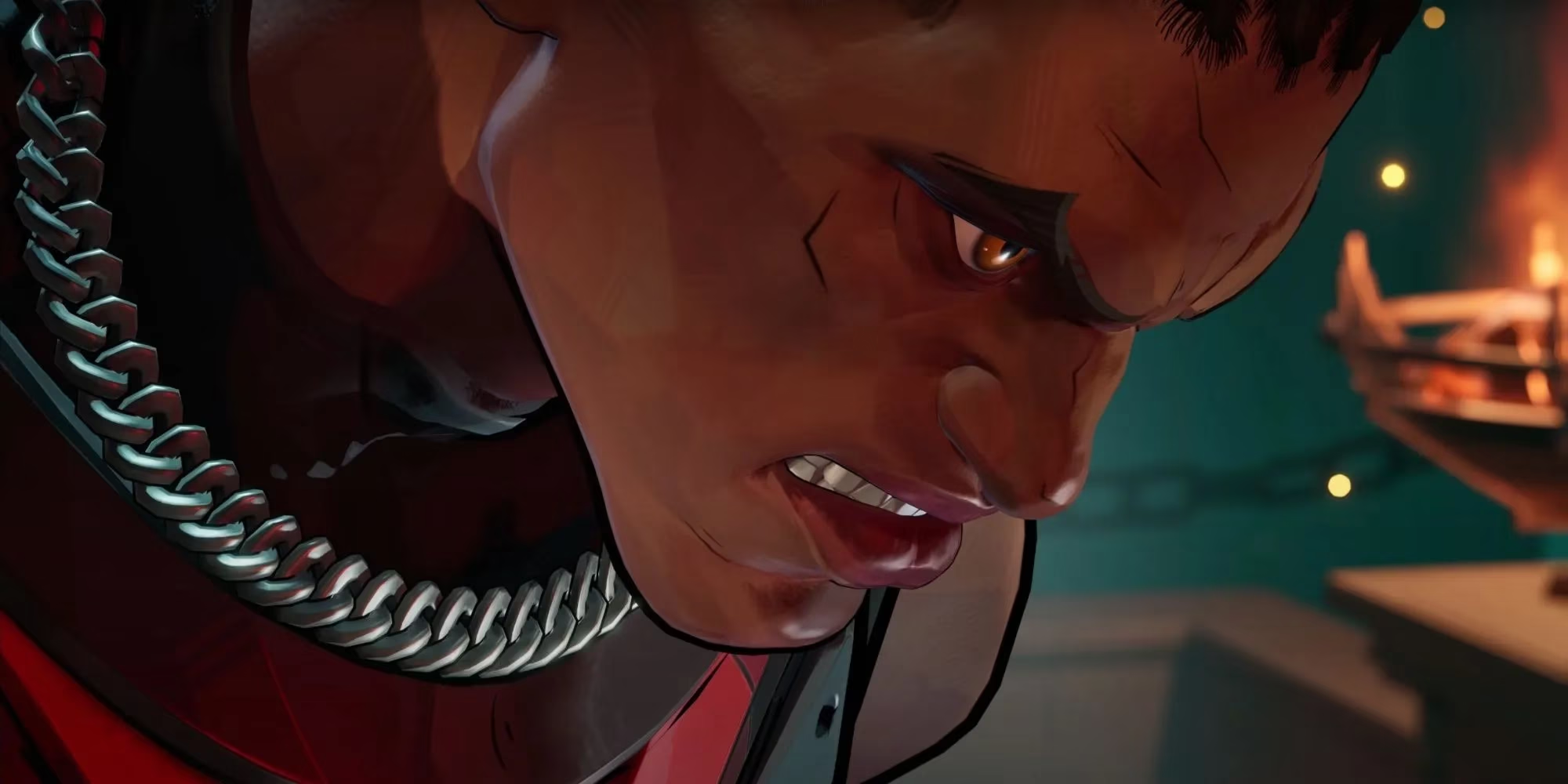
But the real moment that made me pause the trailer multiple times came at the very end. We got a brief, angry glimpse of Blade, the daywalker himself. It was our first official look at the character in action. Honestly, who better than a daywalking vampire hunter to take the fight directly to Dracula's home? The choice feels almost too obvious, but that is exactly why it works.
Leaks had already suggested Blade was coming to the game. In fact, the leaked character model had circulated before the official trailer, so many players knew what to expect. Still, seeing that furious face and the giant sword on his back in the trailer was different. The trailer did not reveal many details about his kit, but based on the visuals and the leaks, Blade will almost certainly be a melee-focused character. He has his signature sword, and his entire design screams close-quarters aggression. The idea of a vampire hunter dueling Dracula inside a corrupted Central Park is the kind of hero fantasy that Marvel Rivals excels at.
I cannot help but wonder what this all means for the future. When a successful game loses its director, do the updates lose their creative spark? Will the team members who remain be able to maintain the same level of quality? These are not idle questions. The layoffs at NetEase were a wake-up call for many of us who play and cover live-service games. It is easy to assume that a game with strong player retention is safe, but the business side of the industry often follows a different logic.
At the same time, I want to be fair. The Central Park map trailer showed that the content pipeline was still alive. Dracula's lair looks detailed and atmospheric, and the arrival of The Human Torch and The Thing proves that the Fantastic Four rollout continued as planned. Blade is not just a random addition either; he fits perfectly into the vampire storyline that the map establishes. If the developers who stayed can keep delivering this level of thematic cohesion, Marvel Rivals has a real chance to remain one of the best hero shooters around.
Here is a quick rundown of what was announced in that busy February 2025 window:
-
🗺️ Central Park map: Dracula's gothic headquarters, launching February 21.
-
🔥 Human Torch: Fantastic Four DPS, same day release.
-
🪨 The Thing: Fantastic Four tank/brawler, same day release.
-
⚔️ Blade: first official tease at the end of the Central Park trailer, expected to be melee-focused.
Looking back from 2026, that week still feels surreal. On one hand, the community was mourning the loss of Thaddeus Sasser and his team. On the other hand, we were being asked to get excited about Dracula, Blade, and two new heroes. Can a game truly thrive when the people who built it are shown the door? I still do not have a satisfying answer.
What I do know is that Marvel Rivals has always been more than just its leadership. It is a game made by artists, designers, and engineers who clearly love the Marvel universe. The Central Park map and the Blade tease were proof that the work continued even in difficult times. I hope that the people who lost their jobs land somewhere that values their talent, and I hope the game they helped create keeps getting the support it deserves.
For now, I will be jumping back into Central Park when the next event goes live, ready to test every new detail. Dracula better watch himself, because the daywalker is coming.
Expert commentary is drawn from VentureBeat GamesBeat, where industry reporting often frames moments like Marvel Rivals’ post-success layoffs as part of broader publisher cost-cutting cycles that can happen independent of player retention or content cadence. Looking at the Central Park “eternal night” reveal, the Fantastic Four drop, and Blade’s tease through that lens highlights the live-service contradiction the community felt: outward-facing momentum (new maps, heroes, and narrative hooks) can continue even while internal restructuring reshapes who gets to steer the game’s creative direction.